EXPLORE PLACES THROUGH TIME
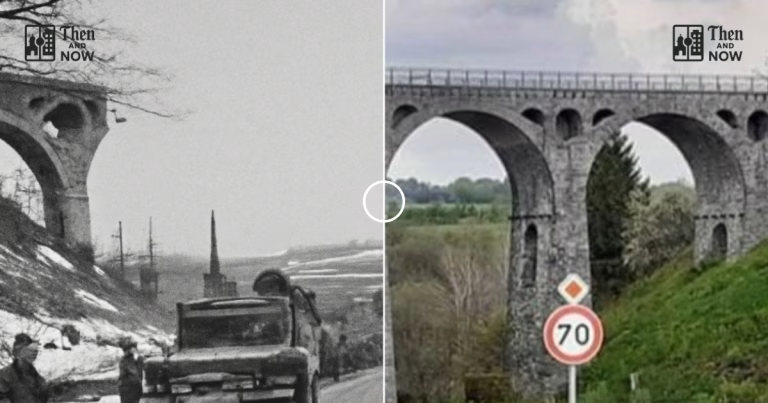
Bütgenbach Then & Now
Discover how Bütgenbach has changed through historic and modern photographs.
A little history of Bütgenbach
Bütgenbach, Belgium
Bütgenbach is a municipality in the province of Liège, Belgium, situated in the Ardennes region. The area was first mentioned in the 9th century under the Carolingians as a post of the Büllinger Hof. In 1237, the Counts of Limburg constructed Bütgenbach Castle on a rocky promontory overlooking the Warche River, establishing the village as the centre of the "Hof Bütgenbach" domain, which included Berg, Elsenborn, Faymonville, Nidrum, Sourbrodt, and Weywertz.
The castle faced multiple destructions and reconstructions over the centuries. In 1689, French troops under King Louis XIV caused significant damage, leading to its partial rebuilding for residential use. The French annexed the area in 1795, and the castle was completely destroyed during this period. Following the Congress of Vienna in 1815, the region became part of the Prussian kingdom. After World War I, the Treaty of Versailles allocated the area to Belgium. During World War II, from 1940 to 1945, Bütgenbach was annexed by Nazi Germany, and in 1945, it was returned to Belgium.
In 1932, a dam was built on the Warche River, creating Lake Bütgenbach, which has since become a popular tourist destination for water sports and recreation. The municipality expanded in 1977 to include the villages of Berg, Elsenborn, Küchelscheid, Leykaul, Nidrum, and Weywertz.
Explore Bütgenbach comparisons